Loading...
Serving Vero Beach, FL and surrounding areas. (772) 588-1084
A sinking slab does not always mean a full replacement. We lift sunken driveways, patios, garage floors, and pool decks back to level - faster and for far less than tearing everything out.
Foundation raising in Vero Beach is the process of pumping material under a sunken concrete slab to fill voids in the soil and push the slab back to level - most residential jobs are completed in a single day, with many small-to-mid-sized slabs lifted in just a few hours.
If you have noticed a sloped garage floor, a sunken section of patio, or a driveway that has dropped along one edge, you are likely dealing with a soil void - a gap that formed when sandy soil shifted or washed away beneath the concrete. In Vero Beach, this happens regularly because of the coastal soil conditions and Florida's intense wet season. The good news is that in most cases, the slab itself is still structurally sound - it just has nothing holding it up anymore.
If your slab has dropped significantly and you suspect the underlying soil has deeper issues, it may be worth reviewing our slab foundation building service - sometimes a full replacement is the smarter long-term investment, and we will tell you honestly which direction makes more sense after the assessment.
When a slab shifts even a small amount, door frames and window frames above it can go slightly out of square. If a door that used to swing freely now drags on the floor, or a window that opened easily now jams, that is worth paying attention to. In Vero Beach, this often shows up in the fall after a wet summer, when soil movement has had months to build up.
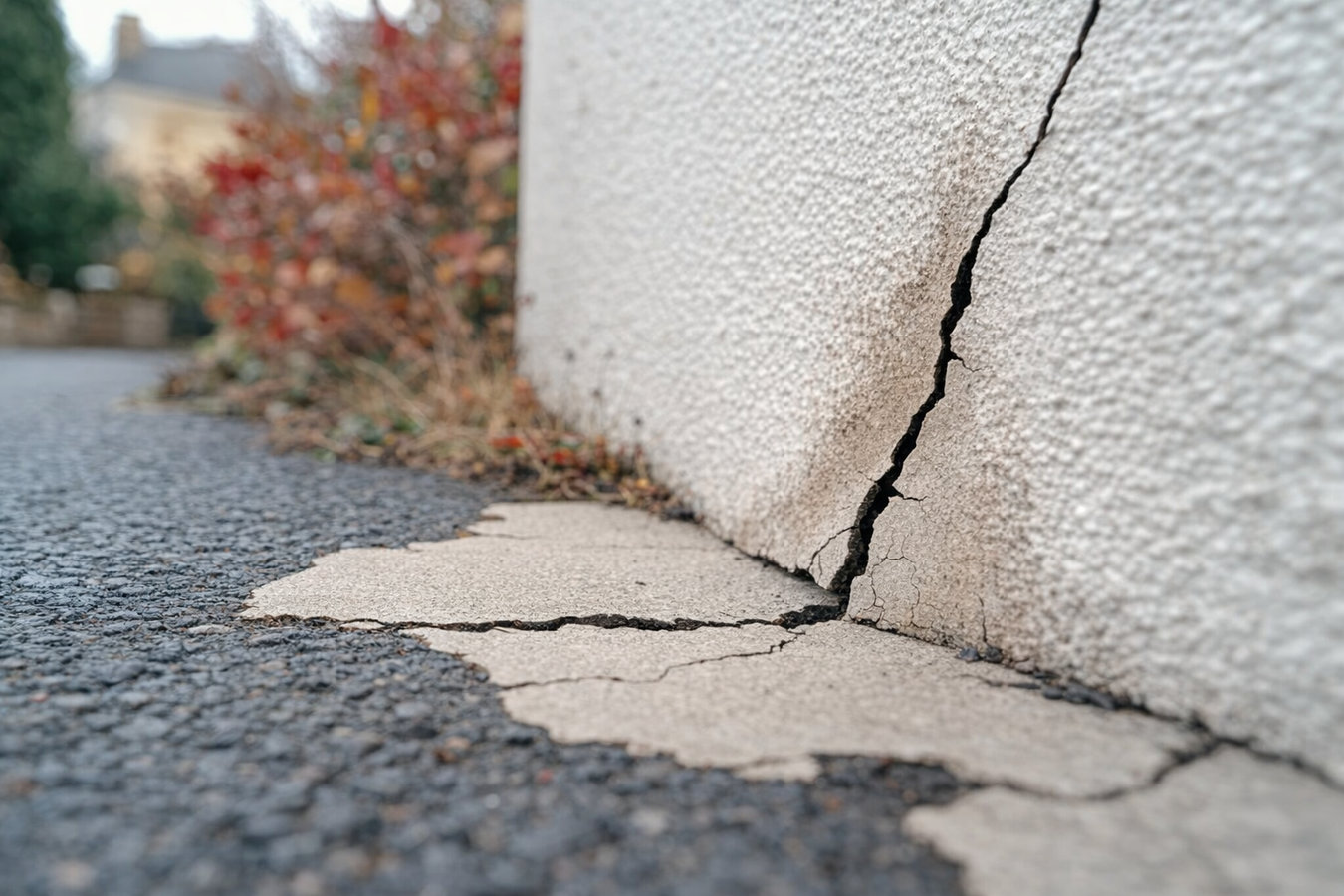
Hairline cracks in concrete are common and not always serious. Cracks that are wider than a pencil tip, run diagonally, or show one side sitting higher than the other are signs the slab has moved. Vero Beach's sandy soil can shift unevenly, so one section of a patio may drop while the adjacent section stays put.
If you can feel a slope when you walk across a garage floor, screened porch, or lanai, the slab has likely settled in that area. Place a level on the floor - a bubble that sits noticeably off-center confirms the surface is no longer flat. This kind of gradual settling is common in older Vero Beach homes where the soil has had decades to compact.
If rainwater collects against the side of your home or along the edge of a slab rather than draining away, the grade may have changed. Standing water near a foundation accelerates soil erosion, making the settling problem worse over time. Given how much rain Vero Beach receives from June through September, this pattern is worth watching closely.
We handle foundation raising for driveways, garage floors, patios, pool decks, walkways, and interior slabs throughout Vero Beach and Indian River County. The process starts with a thorough on-site assessment - we probe the soil around the slab, look at the crack patterns, and check for signs of ongoing drainage problems before recommending a repair approach. We use both mudjacking (a cement-and-soil slurry pumped under the slab) and polyurethane foam injection, depending on the size of the void, the weight of the slab, and the soil conditions. Foam injection uses smaller holes and cures in minutes, making it the preferred choice for most residential work in Vero Beach. If the job connects to structural concrete work, we coordinate with our concrete cutting service to remove and replace sections that are too damaged to raise cleanly.
We also identify and address the drainage issues that caused the settling in the first place. Filling a void without fixing the underlying water problem just delays the next repair. If Indian River County requires a permit for the scope of work, we handle the application and inspection coordination - you should not have to navigate that process on your own.
Best suited for large slabs and heavier lifting jobs where a dense fill material provides the support needed.
Ideal for most residential slabs - smaller drill holes, faster curing, water-resistant, and less disruptive for most homeowners.
For homeowners who want to understand what caused the settling before committing to a repair - we look at soil, drainage, and slab condition together.
After the slab is back to level, open cracks are filled and sealed to prevent water infiltration that could restart the erosion cycle.
Vero Beach sits on the Atlantic Coastal Ridge, where the soil is predominantly sandy and highly permeable. Sandy soil drains quickly, but it also shifts and compresses unevenly when it gets saturated and then dries out - a cycle that repeats every year during Florida's rainy season, which typically runs June through September in Indian River County. When water moves through that sandy soil repeatedly, it carries fine particles away from beneath your slab over time. Eventually a void forms, and the concrete above it has nothing to rest on. This process is not a flaw in how your home was built - it is just what sandy coastal soil does, especially in neighborhoods closer to the Indian River Lagoon where the water table can rise near the surface after heavy rain. Homes built in the 1960s through the 1980s are among the most likely to show this kind of settling, simply because the soil has had more time to move.
The best time to address slab settling is in the spring, before the next rainy season arrives. Waiting tends to let the void grow larger and the slab drop further, which can push a manageable repair toward a full replacement. We work throughout Vero Beach and surrounding communities - including Port St. Lucie and Sebastian - where sandy coastal soils and similar wet-dry weather patterns create the same kinds of settling issues.
When you call, we ask a few basic questions - where the problem is, how long you have noticed it, and whether there are obvious cracks or gaps. We reply within 1 business day and can usually schedule an on-site visit within a few days. You do not need to prepare anything for this first conversation.
We walk the affected area with you, look at the slope, probe the soil around the slab, and check for cracks or separation. This visit typically takes 30 to 60 minutes. You will leave with a clear explanation of what is happening and a written estimate that spells out exactly what work will be done and what it will cost.
Before the work day, clear the area around the slab - move vehicles out of the garage, pull furniture off a porch, or trim plants close to the work zone. The contractor will tell you exactly what needs to move. This prep usually takes less than an hour on your end.
The crew drills small holes through the slab, injects the lifting material underneath, and monitors the slab as it rises back to level. The actual lift can happen in under an hour for a small area. Once the slab is level, the holes are patched, the area is cleaned up, and we walk through the finished work with you before we leave.
Free on-site assessment, written estimate, no obligation. We respond within 1 business day.
(772) 588-1084Our crews have lifted slabs throughout Vero Beach, Port St. Lucie, and Sebastian - areas where the same sandy soil conditions create the same kinds of voids. We know what the Indian River County Building Division requires for permitted structural repairs, and we handle that paperwork on your behalf so nothing falls through the cracks before or after the job.
Before we seal the holes and leave, we show you exactly where the void was, how large it was, and what likely caused it. In Vero Beach, the cause is usually sandy soil shifting after a wet season - knowing that helps you spot early signs in the future. You should leave the job feeling informed, not just relieved.
You can verify our Florida state contractor license on the Florida Department of Business and Professional Regulation website in about two minutes. We carry liability insurance and workers' compensation coverage - and we will provide the certificate directly, not just promise it verbally. For foundation work, there is no acceptable shortcut on licensure.
If your slab is too far gone to raise - badly cracked, crumbling, or broken into multiple pieces - we will tell you, and we will explain why replacement makes more sense than lifting. We are not a one-method operation that forces every job into the same solution. If raising is not the right answer for your slab, we say so up front.
These proof points add up to one thing: a contractor who treats your Vero Beach home the way they would treat their own - with the right method, the right permits, and a straight answer on what your slab actually needs. For more on industry standards for concrete lifting, see the American Concrete Institute, and for Florida-specific licensing verification, visit the Florida Department of Business and Professional Regulation.
When a slab section is too damaged to raise, precise cutting removes only what needs to go - so the rest of your driveway or patio stays intact.
Learn MoreIf raising is not the right answer, we pour a new slab from scratch - designed for Vero Beach's sandy soil and built to current Indian River County code.
Learn MoreVero Beach's summer storms are hard on settling slabs - call now while spring scheduling is still open and get the job done before the next wet season arrives.